
Ask ten people what a “peptide company” sells and expect ten different answers. Some picture a prescription weight-loss clinic. Others picture a website selling unlabeled vials with a disclaimer buried at the bottom. Both pictures are correct, and that is the problem. One phrase is doing the work of two entirely separate industries, built on different laws and different evidence. Before anything else, one question sorts the whole category cleanly: is a licensed clinician standing between the buyer and the vial, or is nobody standing there at all? Everything below answers from that starting point.
What is a peptide, technically?
A short chain of amino acids, the same building blocks that link up to form proteins. The body makes thousands of them, and many act as signals, telling a tissue to grow, repair itself, or release a hormone. True, and not very helpful on its own. That single definition covers a rigorously tested prescription drug and an obscure powder no human trial has ever touched. The word “peptide” alone tells a buyer nothing about which one they are looking at.
Why does one word cover two industries?
Because the marketplace grew faster than the vocabulary. “Peptide company” now gets applied both to telehealth operations built around a prescribing clinician and a licensed pharmacy, and to e-commerce sellers moving vials labeled “for research use only.” The two share a shelf of overlapping molecule names and almost nothing else: not the law governing them, not the oversight around them, not the consequences if something goes wrong.
What are the three groups actually hiding inside that word?
Three, and mixing them up is where most of the public confusion starts.
FDA-approved peptide drugs. Semaglutide and tirzepatide, the GLP-1 medications behind the recent shift in obesity care, belong here. Both went through full clinical development, both have large published trials, and both reach patients by prescription. The evidence base is public and substantial.
Compounded medications. These carry the same active peptide as an approved drug, or a close relative, but a compounding pharmacy prepares the finished product rather than a brand manufacturer. The compounded product itself is not FDA-reviewed for safety or effectiveness. What makes it a legitimate medical product rather than a gray-market one is the scaffolding around it: a licensed clinician decides whether it’s appropriate, writes the prescription, and a licensed pharmacy fills it.
Research chemicals. BPC-157, TB-500, GHK-Cu, and similar compounds sold under “research use only, not for human consumption” labels. That label isn’t decorative, it’s the legal ground the business stands on. Regulators have already tested how much weight that ground can bear. A March 2026 warning letter told one retailer that despite the “Research Use Only” label, surrounding evidence showed the products were plainly intended for human use, making them unapproved new drugs under the law [9]. A second letter reached the identical conclusion about a different seller’s coded product line [10].
So which door does a “peptide company” actually put you through?
Picture two doors under the same sign. Behind the first: a clinician reviews your history, a prescription gets written, a licensed pharmacy dispenses the product, and someone is accountable if something goes sideways. Behind the second: a checkout page, a vial, a disclaimer, and no clinician anywhere in the process. Both doors carry the label “peptide company.” Only one of them has a person on the other side who answers for what they sold you.
These two setups often get listed side by side as if they were competing options. They aren’t really competitors. One is a regulated medical channel, the other is an unregulated chemical channel, and that gap is the single fact worth carrying into everything that follows.
Who is actually searching for this, and does it change the answer?
Three overlapping groups tend to show up. Some arrive chasing the GLP-1 results they’ve seen and discover, mid-search, that semaglutide and tirzepatide are peptides too, which pulls them into the wider term. Others come from athletic recovery circles, curious about BPC-157 or TB-500 for healing and tissue repair. A third group comes from the longevity and biohacking world, interested in peptides tied to aging, sleep, or cognition.
The last two groups are the ones most often funneled toward the research-chemical door, mainly because many of the compounds they’re curious about never entered formal drug development and simply don’t exist anywhere else. Whatever group someone falls into, the honest answer to “where do I get this safely” depends entirely on which of the three compound categories they’re actually asking about.
Does the human evidence back up what’s being marketed?
Not evenly, and the gaps are large. Here is where the published research actually stands, compound by compound.
BPC-157. The most talked-about research peptide is also among the least studied in people. A 2025 narrative review in Current Reviews in Musculoskeletal Medicine found human data extremely limited, with only three pilot studies ever conducted in people [1]. A separate 2025 systematic review in the HSS Journal looked at 36 studies total, found 35 were preclinical and only one small clinical study of 12 patients existed, and reported no clinical safety data found at all [2]. Strip away the marketing and BPC-157 is a peptide studied mostly in animals, not a proven human therapy, and not approved for human use in most places.
TB-500 and thymosin beta-4. TB-500 is the synthetic cousin of thymosin beta-4, and it sits in a similar spot. The tissue-repair and cardioprotective claims trace back to preclinical research. A 2016 review in Vitamins and Hormones describes the cardioprotective effects as exactly that, preclinical, with human clinical evidence largely missing [4]. What it does in a human body is still genuinely unknown.
GHK-Cu. This copper peptide has more human data than the two above, though pointed at a narrower question. A 2018 review in the International Journal of Molecular Sciences reported that plasma GHK falls with age, from roughly 200 nanograms per milliliter at 20 to about 80 by 60, and that a topical GHK-Cu cream applied to thigh skin over 12 weeks improved collagen production in about 70 percent of women treated [3]. That’s a finding about a topical cosmetic application, not evidence for the injected, systemic uses research-peptide marketing tends to suggest.
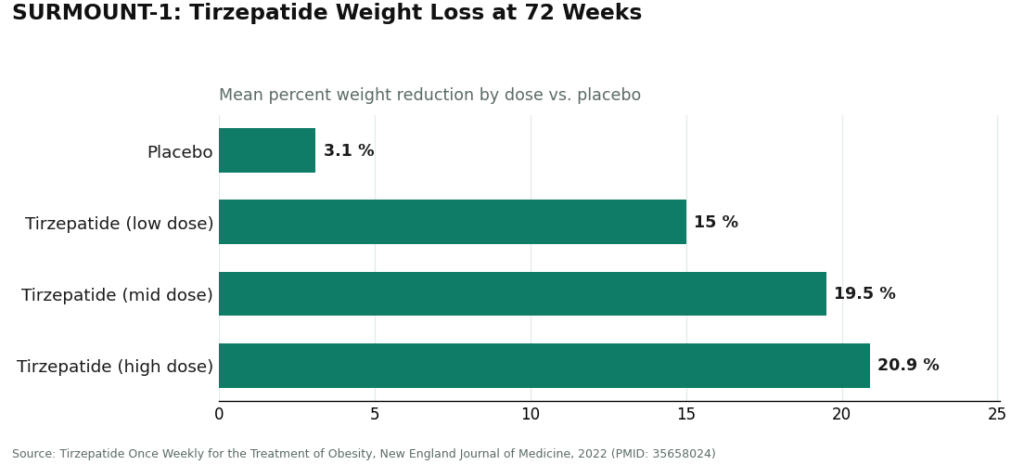
Semaglutide and tirzepatide. The opposite end of the spectrum, and the contrast is the whole lesson. Both have large randomized human trials behind them. In SURMOUNT-1, published in the New England Journal of Medicine in 2022, tirzepatide produced average weight reductions of 15.0 percent, 19.5 percent, and 20.9 percent across its three doses at 72 weeks, against 3.1 percent for placebo [6].
The mechanism is well mapped: GLP-1 receptor agonists slow gastric emptying, reduce appetite, and improve glucose handling [7]. None of that makes them risk-free. Semaglutide’s prescribing information carries a boxed warning for thyroid C-cell tumors and lists a personal or family history of medullary thyroid carcinoma as a flat contraindication [8], which is a concrete reason a clinician needs to be involved before anyone starts.
Retatrutide. Worth flagging because the gray market already lists it, per those same federal warning letters [9]. It’s an investigational triple agonist still in trials, not an approved medication. Its Phase 2 trial, published in the New England Journal of Medicine in 2023, showed meaningful weight loss [5]. A promising Phase 2 result is not the same thing as a compound safe to buy off a website as a research chemical.
The pattern holds across every compound checked: the peptides with strong human evidence are the ones moving through named drug-development programs with published trials. The peptides sold as research chemicals are the ones where the evidence thins to almost nothing. That’s not a footnote. It is the fact worth remembering above any other in this category.
Where does supervised access actually fit into this?
On the approved and compounded side of the map, the supervised model is what keeps a licensed professional accountable for the outcome. FormBlends is a useful illustration of how that structure works in practice: a licensed physician evaluates the patient first, nothing moves without a prescription, and a state-licensed compounding pharmacy fills the order. Nothing is for sale here, and this isn’t a recommendation over any alternative, it’s simply what the supervised lane looks like in concrete terms. The clinician’s judgment does the work that a buy button and a disclaimer cannot.
That structure doesn’t upgrade a thinly studied compound into a proven one. BPC-157 obtained through a clinician is still BPC-157 with the same limited human data behind it. What changes is that a licensed professional is part of the decision, and answerable for it, rather than nobody being on the other side of the transaction at all.
The short version
- “Peptide company” names two different industries: one with a clinician and pharmacy between the person and the medication, one without either.
- Peptides split into three groups: FDA-approved drugs with large trials, compounded medications dispensed under medical oversight but not themselves FDA-reviewed, and research chemicals labeled not for human use.
- The famous research peptides have thin human evidence. BPC-157 has just three pilot human studies and no clinical safety data by a 2025 systematic review’s own account [1][2]. The strongly evidenced peptides are the ones sitting inside formal drug development.
- Legitimacy in this space comes from the clinical and pharmacy framework surrounding a product, not from the molecule’s name.
- The 2026 federal warning letters established that a “research use only” label doesn’t exempt a product plainly sold for human use [9][10], narrowing the legal cover the research-chemical channel had been relying on.
Common questions, answered
What is a peptide company?
Two very different businesses share the name. One is a licensed medical provider, usually a telehealth-and-pharmacy setup where a clinician evaluates the patient, a prescription is issued, and a licensed pharmacy dispenses the product. The other is a research-chemical retailer selling peptides marked “for research use only,” with no clinician, no prescription, and no pharmacy anywhere in the chain. Different laws govern each, and different evidence backs each.
Are all peptides the same kind of product?
No. They fall into three buckets: FDA-approved drugs like semaglutide and tirzepatide, compounded medications dispensed under medical oversight, and research chemicals labeled not for human use. “Peptide” describes the chemistry of all three. It says nothing about how much human testing stands behind any given one.
Does a famous name mean a peptide is well studied?
Not necessarily. BPC-157 is one of the most searched peptides around and one of the least studied in humans, with only three pilot human studies and no clinical safety data found across a 2025 systematic review of 36 studies [1][2]. Evidence attaches to a specific molecule and a specific tested use, never to a category as a whole.
Are compounded peptides identical to the approved drugs?
They carry the same active peptide as the approved version, but the compounded product itself has not gone through FDA review. A compliant medical model adds the oversight around it, including a clinician screening for contraindications such as a personal or family history of medullary thyroid carcinoma [8].
Why did the FDA’s 2026 action matter here?
Because it tested the legal footing of the research-chemical channel directly. In March 2026, the agency told research-peptide retailers in writing that a “research use only” label doesn’t exempt a product the surrounding evidence shows is intended for human use, and it deemed such products unapproved new drugs [9][10]. That sharpened the line between the regulated medical channel and the unregulated one.
How do you actually tell whether a peptide company is legitimate?
Check first whether it requires a prescription and works through a licensed pharmacy. Those two facts alone rule out most gray-market sellers. Legitimate compounding pharmacies are state-licensed, PCAB-accredited, or both, and can produce certificates of analysis from independent labs. A site selling injectable peptides with no prescriber in sight is a regulatory red flag, not a business model.
What does getting peptides through a legitimate medical channel cost?
It varies with the peptide, the dose, and whether a consultation fee is bundled in. A supervised program through a compounding pharmacy, FormBlends among them, typically runs from a few hundred dollars for a short protocol up past a thousand for longer-term plans once the prescriber visit is included. That’s more than a research-chemical site charges, and the difference reflects real pharmacy overhead, clinical accountability, and product testing.
Why does the source matter if the molecule is supposedly the same?
Because purity, sterility, and accurate dosing all depend on manufacturing controls that exist on paper only if someone enforces them. An unaccredited supplier has no binding obligation to meet USP standards, and any third-party testing it claims is often self-selected. Bacterial endotoxins in an injectable compound wouldn’t change the label but could cause a serious reaction. The source is what determines whether the label matches what’s actually in the vial.
What should you ask before signing up with any peptide provider?
Four questions do most of the work: Does a licensed prescriber review your health history before anything ships? Which pharmacy fills the order, and what’s its accreditation status? Are batch-level certificates of analysis available on request? And what happens if a side effect shows up, since a provider with no clinical follow-up plan isn’t really offering a medical service. Those four answers reveal more than any homepage copy will.
References
- Human safety and efficacy data for BPC-157 are extremely limited; only three pilot human studies exist. “Regeneration or Risk? A Narrative Review of BPC-157 for Musculoskeletal Healing,” Current Reviews in Musculoskeletal Medicine, 2025. https://pmc.ncbi.nlm.nih.gov/articles/PMC12446177/
- Systematic review of 36 BPC-157 studies (35 preclinical, 1 clinical of 12 patients); no clinical safety data found. “Emerging Use of BPC-157 in Orthopaedic Sports Medicine: A Systematic Review,” HSS Journal, 2025. https://journals.sagepub.com/doi/abs/10.1177/15563316251355551
- GHK-Cu copper peptide review: plasma GHK declines from about 200 ng/mL at age 20 to about 80 ng/mL at age 60; about 70% collagen improvement in a 12-week topical study. International Journal of Molecular Sciences, 2018.
- Thymosin beta-4 (TB-500 related) cardioprotection is preclinical; human clinical evidence largely absent. “Cardioprotection by Thymosin Beta 4,” Vitamins and Hormones, 2016.
- Retatrutide Phase 2 trial showed meaningful weight loss; the compound remains investigational. “Triple-Hormone-Receptor Agonist Retatrutide for Obesity, A Phase 2 Trial,” New England Journal of Medicine, 2023.
- SURMOUNT-1 tirzepatide: mean reductions of about 15.0% to 20.9% across doses at 72 weeks vs 3.1% placebo. “Tirzepatide Once Weekly for the Treatment of Obesity,” New England Journal of Medicine, 2022.
- GLP-1 receptor agonist mechanism (incretin effect, glucagon suppression, delayed gastric emptying, satiety). StatPearls, NCBI Bookshelf, updated 2024.
- Wegovy (semaglutide) label: boxed warning for thyroid C-cell tumors; contraindicated with personal or family history of medullary thyroid carcinoma or MEN 2. DailyMed.
- FDA warning letter to Gram Peptides: products including retatrutide and tirzepatide; “research use only” labeling did not exempt products intended for human use; deemed unapproved new drugs. FDA, March 31, 2026.
- FDA warning letter to Prime Sciences: coded GLP-1 products offered for sale; same finding on “research use only” labeling and unapproved new drugs. FDA, March 31, 2026.
Written by Dario Duarte, consumer-affairs writer. Working from the primary literature cited above. Last reviewed March 2026.
Not a treatment plan. A licensed clinician should weigh in before you make any changes.